
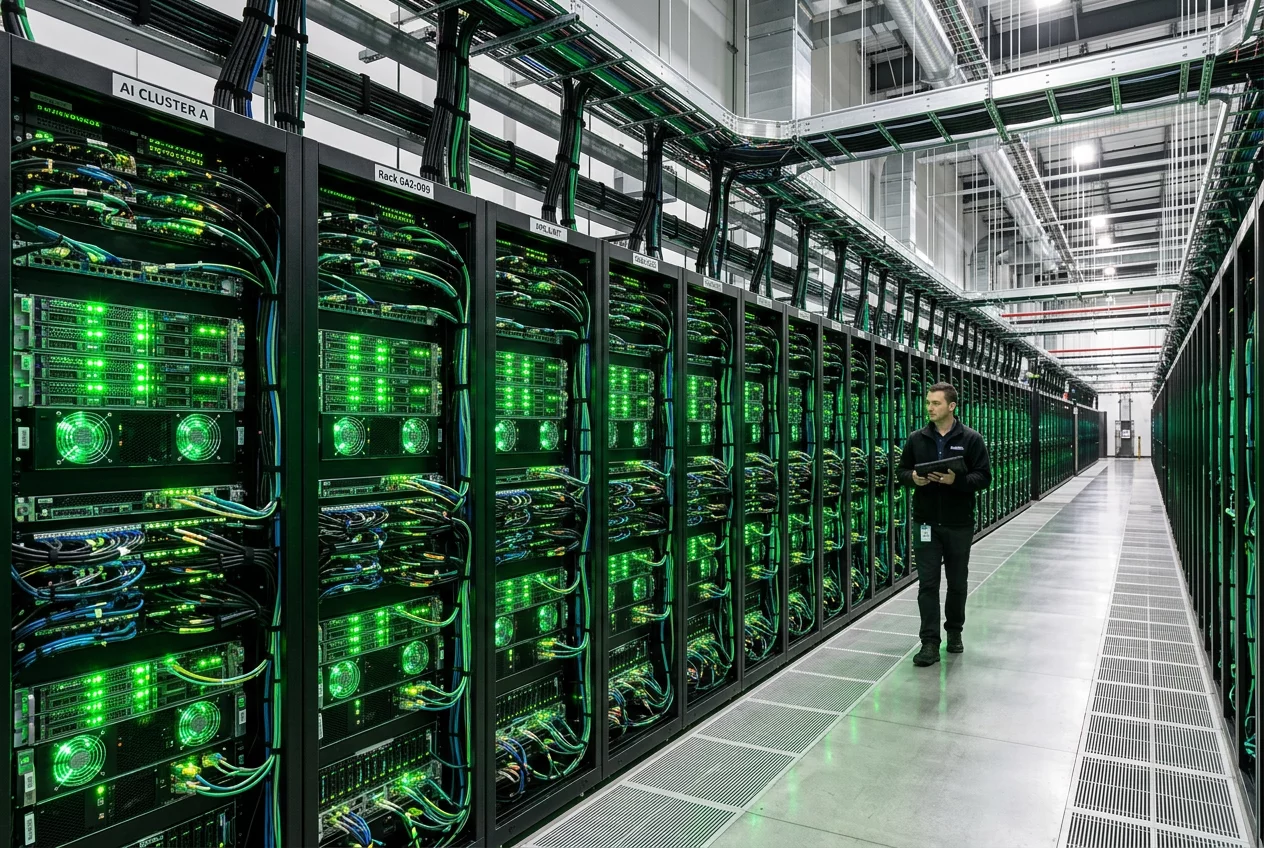
The Foundation of Modern Intelligence
Artificial intelligence, particularly the training of Large Language Models (LLMs), requires a massive scale of parallel processing power. NVIDIA’s latest deployment across the UK tech corridors represents more than just a hardware upgrade; it is a strategic infrastructure shift. By deploying thousands of H200 Tensor Core GPUs, the initiative provides the computational density needed to handle trillions of parameters. These clusters are built with NVIDIA’s Hopper architecture, which integrates dedicated engines for Transformer models, slashing the energy consumption and time required for deep learning iterations.
Technical Architecture and Interconnects
Raw GPU power is only one part of the equation. The deployment emphasizes high-throughput networking using InfiniBand technology. This ensures that data moves between nodes with minimal latency, allowing thousands of GPUs to work as a single, unified supercomputer. The infrastructure also utilizes NVLink Switch Systems, providing a high-bandwidth, low-latency fabric that is essential for the communication-heavy nature of neural network training.
- Compute Density: Thousands of H200 nodes optimized for FP8 precision.
- Networking: Quantum-2 InfiniBand for multi-node scaling.
- Storage: All-flash storage arrays to feed massive datasets into the compute pipeline.
- Software Stack: Full integration with NVIDIA AI Enterprise for seamless deployment.
Impact on the UK AI Ecosystem
For UK researchers and tech firms, this infrastructure removes a significant bottleneck. Previously, large-scale training often required outsourcing to international cloud providers, which raised concerns about data sovereignty and high costs. Now, domestic institutions can leverage local clusters to develop proprietary models, ranging from healthcare diagnostics to financial risk assessments. This deployment is a catalyst for the next wave of UK-born AI unicorns.
How does this help small startups?
Through government-backed access programs and shared innovation hubs, smaller entities can rent compute time on these clusters, reducing the barrier to entry for building advanced neural networks.
Discussion
No comments yet. Be the first to leave a comment.
Leave a comment